The latest writings from our team
The latest industry news, interviews, technologies, and resources.

The latest industry news, interviews, technologies, and resources.
Automate the thing that happens most often and needs you least. A simple test for picking the first one, and the two worth doing before anything else.
 Arafat Ul Shezan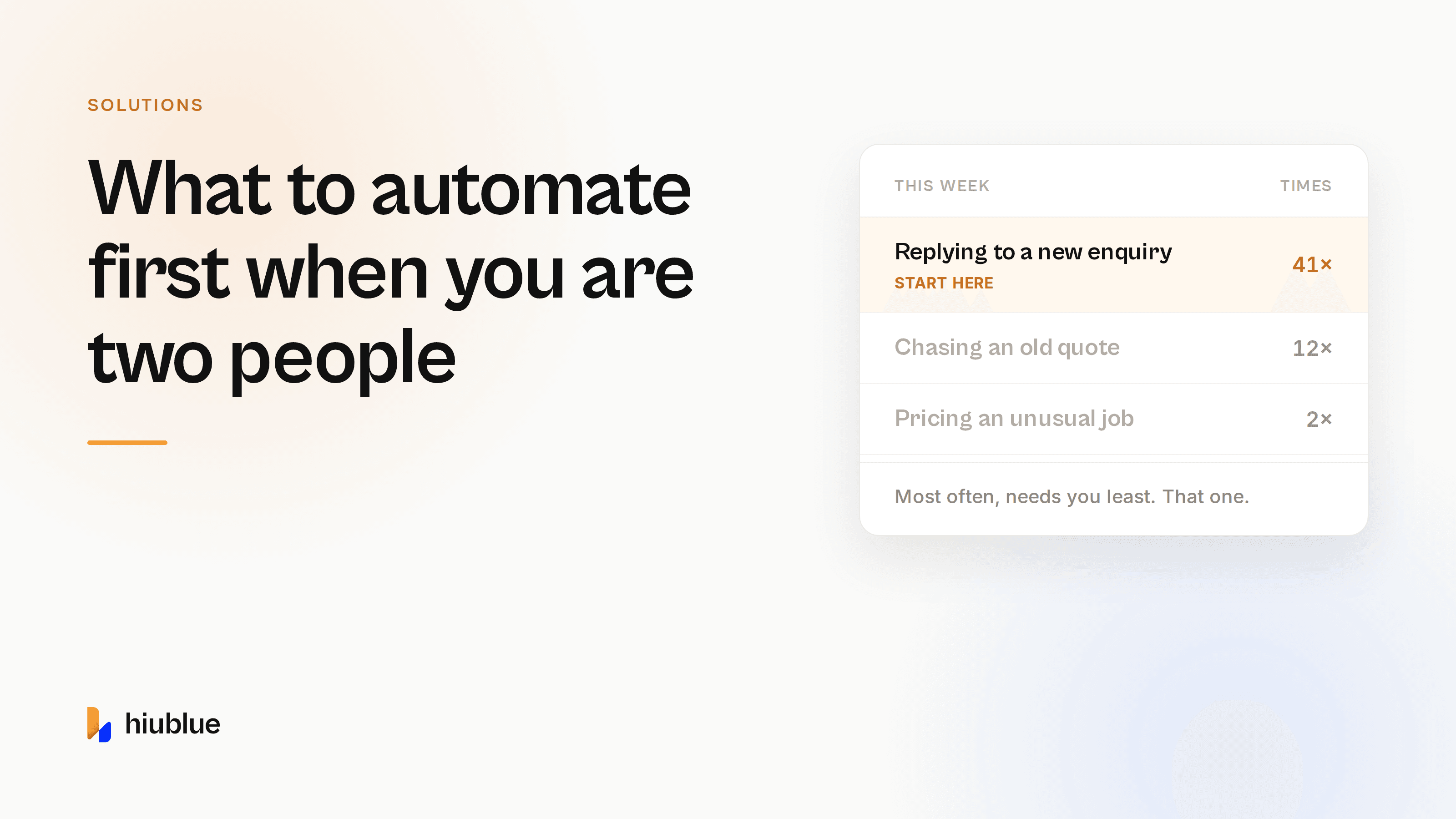
What to automate first when you are a two-person operation
Automate the thing that happens most often and needs you least. That is the whole rule. Not the thing that annoys you most, not the thing a software demo made look impressive. The most frequent, least skilled thing on your plate.
Most small operations get this backwards. They automate something clever and rare, feel good about it, and keep doing the boring thing forty times a week by hand.
Take a week and write down everything that interrupts you. Next to each one put two numbers: how many times it happened, and how much of your actual expertise it required.
The top of your list is almost never the interesting work. It is answering "are you available Thursday", it is sending the same three sentences about what a callout costs, it is chasing someone who said they would confirm and did not. Each one takes ninety seconds. Each one happens constantly. Each one requires nothing that only you can do.
That is what you automate. Not because it is hard, but because it is eating a whole day a week in ninety-second slices.
The instinct is to map out a big process: lead comes in, gets scored, gets routed, gets nurtured, gets assigned. Do not start there. You will spend two weeks building it, and it will break the first time someone replies with something unexpected.
Start with one thing: what happens in the first two minutes after someone contacts you. That is one message. You can write it today, you can read every one that goes out for a week, and you will know within days whether it is working.
Once that is solid, add the next step. A process that grew one link at a time is one you actually understand. A process you designed in one sitting is one you will be afraid to change.
Everyone's second automation should be the same: the follow-up nobody has time to send.
You quoted someone on Tuesday. They said they would talk to their partner. It is now the following Monday and you have not thought about them since, because six other things happened. That quote is not lost to price or to a competitor. It is lost to your memory.
One follow-up, on a timer, referencing the specific job you quoted. That is it. It costs nothing to run and it recovers work you already did the hard part on.
If you only ever do two automations, do these two. The instant first reply, and the one follow-up. Most of the value is here, and both are small enough to get right.
Anything with real judgement in it. Pricing a non-standard job. Deciding whether to take on a difficult customer. Anything where being wrong costs you money or a relationship.
Also: anything you do rarely. A thing that happens twice a month is not worth a week of setup, even if that thing is tedious. Tedium is not the metric. Frequency is.
And be careful with anything that sends more than one message without you reading it first. The failure mode of automation is not that it stops working. It is that it keeps working, on the wrong thing, at volume, while you are not looking.
Pick the number before you build, not after. If you are automating the first reply, the number is median minutes to first response. If you are automating follow-up, the number is how many quotes got a second touch.
Check it two weeks later. If it did not move, the automation is not working, no matter how good the dashboard looks. Turn it off or fix it. Something that runs and does not change a number is worse than nothing, because it makes you believe the problem is handled.
The most common mistake is not picking the wrong thing. It is picking something too big, running out of energy halfway, and ending up with a half-built process nobody trusts.
One message. One timer. Prove it moves a number. Then add the next piece.
What should a small business automate first?The highest-frequency, lowest-judgement task you have, which is almost always the first reply to a new enquiry. Automate that before anything else.
Is it worth automating if it is only two of us?Yes, and arguably more than at ten people. At two people every interruption comes out of billable work. There is nobody to absorb it.
How do I know if an automation is actually helping?Decide which number it should move before you build it, then check that number two weeks in. Response time, follow-up rate, jobs booked. If nothing moved, it is not working.
Should I automate my quoting?Not first, and often not at all. Quoting carries judgement and being wrong is expensive. Automate getting to the quote faster instead, which is where the delay usually is anyway.
What is the most common mistake?Building something too large to finish. A half-built process gets abandoned, and then people stop trusting the next one you try.