The latest writings from our team
The latest industry news, interviews, technologies, and resources.

The latest industry news, interviews, technologies, and resources.
A new lead is warmest in the first few minutes, not the next morning. Where your response time actually goes, and how to close the gap without hiring anyone.
 Arafat Ul Shezan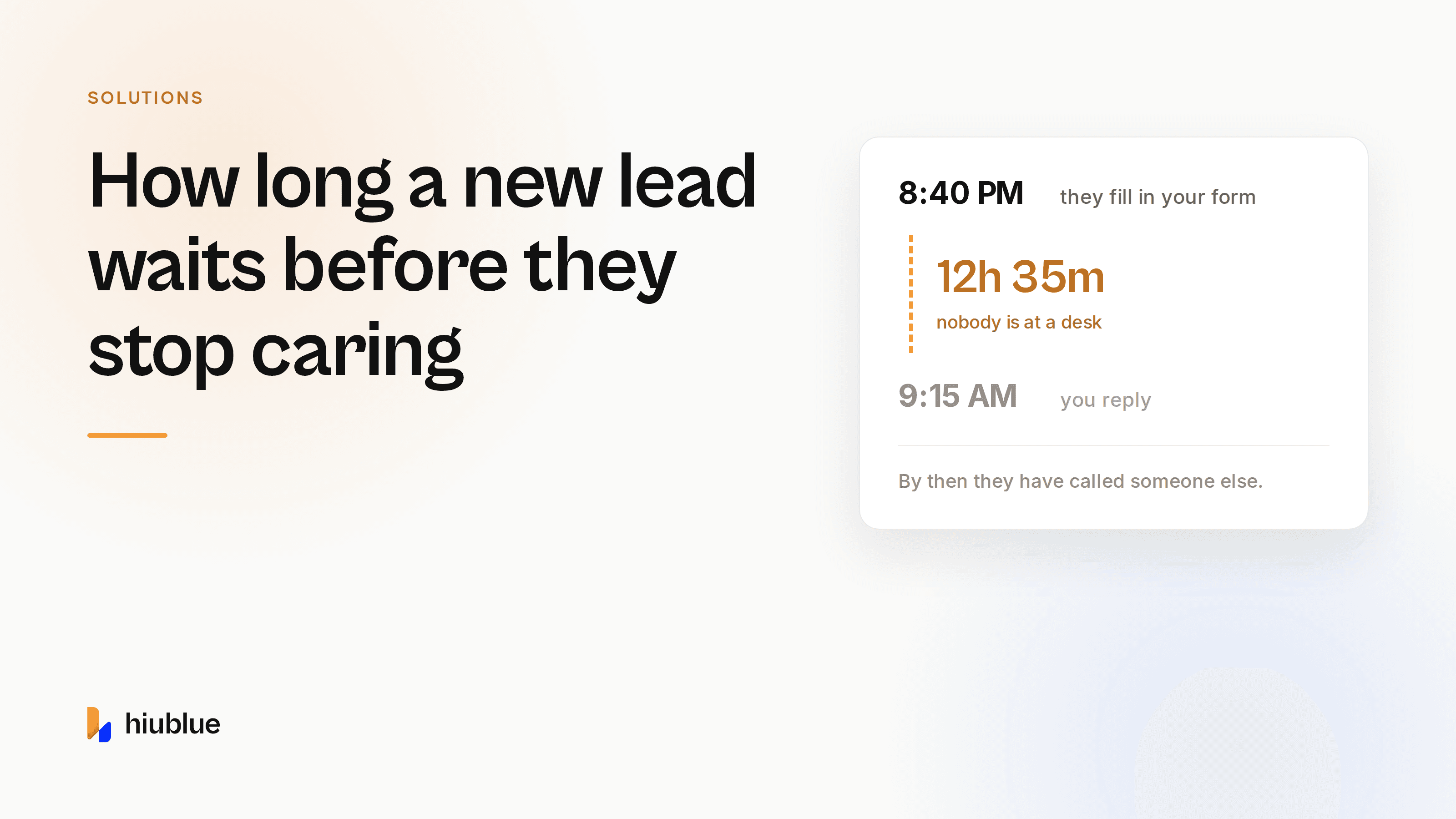
A lead fills in your form at 8:40 on a Tuesday evening. You see it at 9:15 the next morning. In those twelve hours they filled in three more forms, spoke to someone who picked up, and stopped thinking about you. The job was never lost on price. It was lost overnight, while nobody was at a desk.
Response time is the cheapest thing you can fix in your business and the thing almost nobody measures.
There is a well known finding in lead response research that contact rates fall off sharply after the first few minutes, and keep falling by the hour. The exact multiplier varies by study and by industry. The shape does not. A lead answers you when they are still on your website. They stop answering once they have moved on with their evening.
You do not need the research to believe this. Think about the last time you requested a quote for anything. The company that called you back while you still had the tab open is the company you talked to.
Ask most owners how fast they respond and they will say "same day, usually." Then you look at the timestamps.
The delay is almost never laziness. It is structure. A form lands in an email inbox that nobody watches after six. A call comes in while you are under a sink with your phone in the van. A message arrives on Instagram and stays there for a week because Instagram is not where you work. The lead did reach you. Your business just had no surface that was awake.
That is the real problem. Not effort, not intent. Coverage.
The fix is not a person sitting up until midnight. It is having something that answers in your name while you sleep, and that can still be a real conversation in the morning.
A worker with its own number picks up the thread at 8:41. It answers the question they actually asked, confirms what they need and when, and books the slot if the slot is bookable. When you open your phone the next morning, you are not reading a notification. You are reading a conversation that already happened, with the details filled in.
The lead never waited. You still slept.
There is a bad version of this, and you have been on the receiving end of it. You submit a form and instantly get four texts, two emails and a call from a number in another country, all clearly automated, none of them referring to the thing you asked about.
Fast is not the same as loud. One reply that answers the actual question beats six that announce themselves. The test is simple: read the first message out loud. If it sounds like a broadcast, it is one.
The difference comes from memory. A worker that knows what they filled in, what page they were on, and what you already discussed last month writes a different first line than a template does.
You cannot improve this until you can see it. Three numbers, and you can pull them by hand if you have to.
Median time to first response.Not average. The average hides the good ones. Take every lead from the last thirty days, measure the minutes from their message to your first reply, and take the middle value.
Percentage answered outside business hours.If a third of your leads arrive after six and none of them get a reply until nine the next morning, you have found your gap.
Contact rate by response bucket.Split your leads into replied-within-five-minutes, within-an-hour, and later. Look at how many of each turned into a conversation. This one usually ends the argument on its own.
Do this once, by hand, before you automate anything. The number is what will convince you, and it is what will tell you whether the change worked.
If your median is under five minutes and your after-hours coverage is solid, your response time is not your problem and you should go look somewhere else. That is a real possible outcome and it is worth knowing.
If it is not, you now know the size of the leak, in leads, for the last thirty days. That is a number you can act on.
How fast should you respond to a new lead?
As close to immediately as you can manage, and certainly within five minutes while the person is still on your site. Response quality matters too, but no amount of quality recovers a reply sent the next morning.
Does responding at night actually help, or does it annoy people?
It helps, as long as the reply is relevant. People who submit a form at nine in the evening are actively looking at that moment. A reply that answers their question is welcome. A generic blast is not.
Is an automated first reply worse than a slower human one?
Only if it reads like an automation. A reply that references what they asked about, in a normal voice, from a number they can call back, outperforms a human reply that arrives twelve hours later.
What if I cannot answer their question without checking something?
Say that. "Got it, I need to check the parts on this one, I will come back to you before noon" is a complete and good first response. The point is that someone is there, not that everything is resolved.
Want to see your own response times? Book a demo and we will run your last thirty days of leads through it, with a worker named after your team.